Support me and read the full colour comic over on my Patreon NOW Eisner and Harvey NOMINATED!

0 73261
 

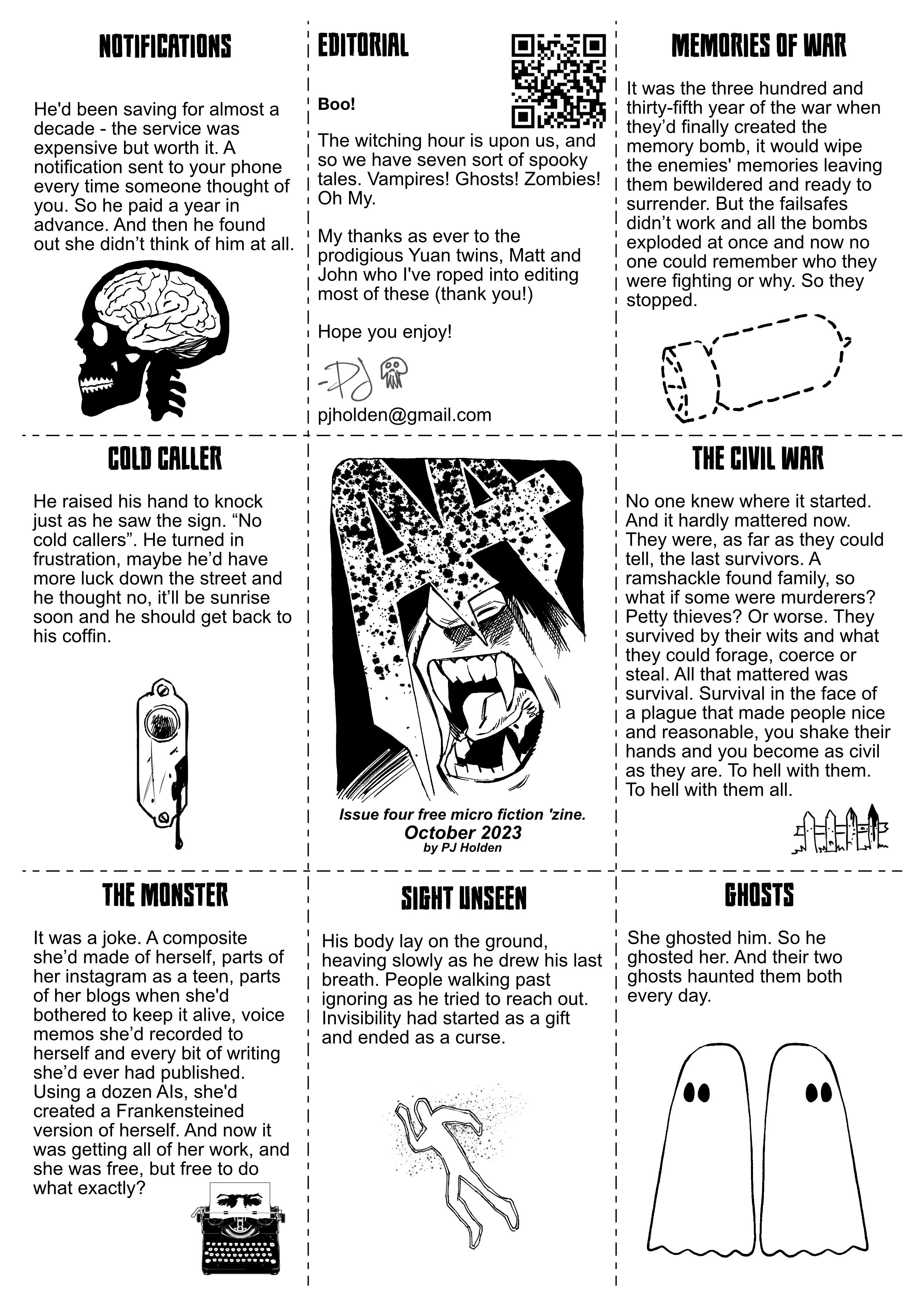
A4 Issue Four

If you prefer you can download the pdf here.

My unending gratitude to Matt and John Yuan (deputy publishers of 1First Comics) who volunteered way back on issue 1 to proofread (off the back of a plaintive twitter plea) and ending up both being great proofreaders and even better editors - constantly encouraging and giving little notes that never alter the fabric of the story but always help.

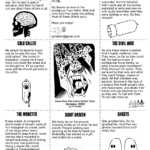
Stories this issue:

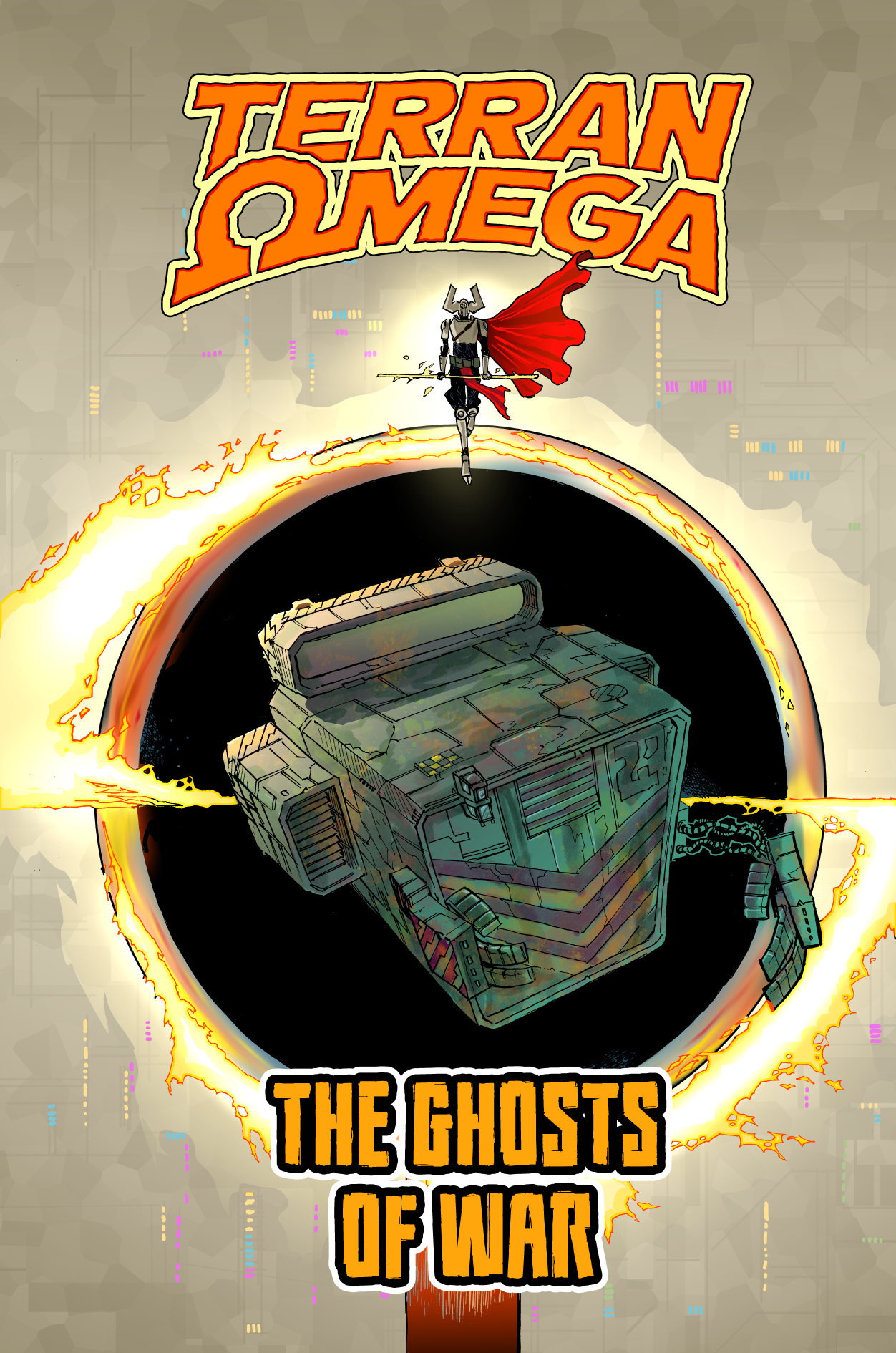
Notifications, Memories of War, Cold Caller, The Civil War, The Monster, Sign Unseen, Ghosts.

A4 Issue Four Notes!

Gah, two stories with War in the title. So annoying. Hadn't spotted it until now, but there it is. It will be my eternal shame.

There were two things drilled in to me from English lessons in secondary school (which I did rather enjoy, I loved writing, and was told to apply for O-Levels early, so I did, and then I didn't do any work because I was fundamentally lazy - so failed it) anyway, the two things: never use the word got/gotten (I think this was my teachers personal bugbear, with teenagers writing "I got given a book then got a clip round the there and got out of there, before he got me" even I'm uncomfortable seeing the word "got" in anything I write) and never repeat a word if you can help it (obvious "I", "and" and so on are all fine). So two wars. Not good. Am annoyed. (Should point out, this is entirely a quirk of my own making!)

From hereon in there will likely be spoilers!

I had planned on a halloween all horror special - or at least as best as I'm able, but of course, I couldn't quite come up with every single story as a horror, so let's start with the least horror like story:

Notifcations

I suppose this and Ghosts share a very common through line, rejection and knowing the person who rejected you never even thinks of you. For a full exploration of this idea, watch the amazing "The Eternal Sunshine of the Spotless Mind".

Memories of War

There's a lot going on in the world, and much of it can be traced back so far that you'll never find the beginning point (hello from Northern Ireland!) - and the question is, if everyone lost their memories would those wars still continue. (this story optimistically says we'd all stop, I have a horrible feeling we wouldn't)

Cold Caller

Phew! Lighter fair! Actually there's a different story that uses the same sort of idea (the no-hawkers caveat that many people have at their door) I've been sitting noodling as a short comic for a few years (how many? oh man, it's embarrassing to tell - but let's say I first thought of it pre-pandemic) it would be far too long to do as one of these stories, so this slightly different version of it popped in to my head.

I am pretty proud of that title though, it came late - after I'd written a bunch of the stories and I was thinking "gah, now i need a title" and ping! there it was!

I did want to do stuff that was just a smidge lighter than last issue, because I've been told some of this stuff is DARK. I think of it all in the abstract, words on paper rather than real monsters. But we're haunted by the real and the imaginary, I suppose.

The Civil War

I saw a writer (a good writer;   it'll be a good book) talking their new Zombie book and it got me thinking, that zombie stories tend to be the ultimate "yeah of course I was the assehole prepping for the end of the world, and look, I WAS RIGHT" and I thought "what if instead of it being zombies, it's that everyone was just really really nice to each other ... oh... those asseholes wouldn't change..."

The Monster

I'll be honest, andI bet readers can tell, I shoehorned frankenstien in too this (because I wanted monsters, dammit)

Here's my orginal story idea from the apple notes app:

He had fragmented himself, Pumping his entire written and audio corpus through AI Large Language Models, and created an army of bots, one for each of the balkanised social media platforms. And he was finally free. Free to get on with work.

Is it better? it might be.

Sight Unseen

This could be policitical satire, I suppose. In the hands of a better writer. Instead it's simply a piece of fiction.

Ghosts

Gotta be honest, I just loved the shape and sound of the story. I love that it works on a couple of levels.  It pretty much came out fully formed, and so short. Honestly this is the joy of these shorts, there's not an ounce of fat on the idea, there's no point trying to extend it, and there's a sort of poetic quality to it. Anyway, might be one of my favs.


Hope you enjoy it, I would love to know what you think - you can fire me off an email to pjholden at gmail dot com if you like!

#14 “Pig”


Long ago a pregnant sow escaped butchery in Hampstead, fleeing into the sewers below. Nourished on refuse, her hoglets interbred, each generation growing more monstrous and ferocious. Only the constant flow of the subterranean river Fleet prevents their escape.

—–

In Volume Two of Henry Mayhew’s London Labour, and the London Poor, published in 1851, the author recorded a very odd piece of of London Folklore, or Urban Legend:

“There is a strange tale in existence among the shore-workers, of a race of wild hogs inhabiting the sewers in the neighbourhood of Hampstead.  

The story runs, that a sow in young, by some accident got down the sewer through an opening, and wandering away from the spot, littered and reared her offspring in the drain, feeding on the offal and garbage washed into it continually. Here, it is alleged, the breed multiplied exceedingly, and have become almost so ferocious as they are numerous.  

This story, apocryphal as it seems, has nevertheless its believers, and it is ingeniously argued, that the reason why none of the subterranean animals have been able to make their way to the light of day is, that they could only do so by reaching the mouth of the sewer at the river-side, while, in order to arrive at that point, they must necessarily encounter the Fleet ditch, which runs towards the river with great rapidity, and as it is the obstinate nature of a pig to swim against the stream, the wild hogs of the sewers invariably work their way back to their original quarters, and are thus never to be seen.  

What seems strange in the matter is, that the inhabitants of Hampstead never have been known to see any of these animals pass beneath the gratings, nor to have been disturbed by their gruntings. The reader of course can believe as much of the story as he pleases, and it is right to inform him that the sewer-hunters themselves have never yet encountered any of the fabulous monsters of the Hampstead sewers.”

Charles Dickens himself  (briefly) mentioned the monster pigs in a piece published in his own periodical Household Words, in 1852:  

“We have traditions and superstitions about almost everything in life, from the hogs in Hampstead sewers to the ghosts in a shut-up house.”

An article published in the Daily Telegraph, on the 10th of October 1859, also mentioned the legend:

“It has been said that beasts of chase still roam the verdant fastness of Grosvenor Square, that there are undiscovered patches of primeval forest in Hyde Park, and that Hampstead sewers shelter a monstrous breed of black swine, which has propagated and run wild against the slimy feculence, and whose ferocious snouts will one day up-root Highgate archway, while they make Holloway intolerable with their grunting.”

Tales of Hamsptead’s subterranean monster pigs seem to be the English, Victorian predecessor of the American Urban Legends of alligators living and breeding in the sewers beneath various cities. It is worth noting however, that in March 1984 a living Nile crocodile was pulled out of a sewer in Paris (a city famed for its labyrinthine catacombs). The crocodile, named Elenore, currently lives at the Aquarium in Vannes. So, perhaps the swine are still down there somewhere, running wild against the slimy feculence…  

#13 “Chronos”

Chronos was the Ancient Greek word for time, Cronos their sickle carrying God of Agriculture. Romans related Cronos to their own Saturn, and made him an old man. His sickle became a scythe, and Cronos became Old Father Time who, in turn, became The Grim Reaper.

Cronos, or Cronus, or Kronos, was an Ancient Greek God; one of the original Titans, who were the divine descendants of Uranus, the sky, and Gaia, the earth.   In Athens, on the twelfth day of the Attic month of Hekatombaion, a festival called Kronia  was held in honour of Cronus to celebrate the harvest, suggesting that,  as a result of his association with the virtuous Golden Age, Cronus  continued to preside as a patron of the harvest. The sickle Cronos is usually depicted holding however, is nothing to do with the harvest. It was used as a weapon to castrate Uranus (his father) at the behest of his mother.  Uranus’ testicles were then cast into the sea and out of the sea-foam came the goddess Aphrodite.

Cronus was also identified in classical antiquity with the Roman deity Saturn, who was also (amongst other roles) a harvest deity, and who also carried a sickle. Saturn was depicted as an older, bearded man and in time his sickle was replaced with a more modern tool: a scythe. Saturnalia – Saturn’s own festival – was held each December and was associated the temporal transition of the New Year, and with the passing of time in general. His increasingly aged appearance came to represent the old year about to meet its end. 

Between the 16th and 18th centuries, the figure of a Father Time became a popular subject in art. Father Time is time personified – an old man with a long beard who carries a scythe.  During the Renaissance he was also often depicted with an hourglass, and sometimes even with wings. 

The skeletal image of Death personified goes back centuries (if not longer), but the Grim Reaper with his scythe is a direct descendant – or perhaps more evolution – of Father Time. During Victorian times, when the concept of Momento Mori  (Latin for ‘remember that you must die’) became popular, the Gothic figure of the skeletal Grim Reaper fitted the aesthetic perfectly. 

#12 “Morrigan”

In the grand Irish epic of the Tain Bo Cuailnge, Nemain –  personification of the frenzy and havoc of warfare – confuses the soldiers on the field of battle, causing them to fight and kill their own.  

The Morrigan. Phantom Queen. Shape-shifting Triple Goddess. As Battle Crow she flies as a harbinger of death and defeat. As the hag she is the crafty and cunning old witch of Fairy Tale. And as Nemain she is Goddess of War, able to kill 100 men with a mere cry.

The Morrígan is one of the strangest deities in Irish Celtic mythology. Tripartite goddess of war: she is made up of three separate personalities or aspects. These three are known as Morrígu, Badb, and Nemain, but also sometimes Macha, and Anann,. There is some debate as to whether “Morrigan” is merely a title these separate Goddesses, or heroines held (like The Gorgons of Greek Mythology), or whether they were genuinely all different forms taken by The Morrigan.  

The “mor” in Morrigan comes from the same route as the Old English word “maere”, meaning terror or monstrousness and which survives in modern English in the context of “nightmare”. The “rígan” translates as “queen”, giving the Godess the title of Terror Queen, Phantom Queen, Mare Queen, or simply Great Queen.  

Badb (“crow”) is more often known as “Badb Catha” (meaning “Battle Crow”) and as such is associated with war and death. Her appearance would foreshadow imminent bloody battle, and on the field of war the Battle Crow would create deliberate fear and confusion among enemy soldiers. Possibly because of this, the battlefield is referred to some Celtic literature as “the garden of the Badb” (although crows do like carrion, so there may be a rather obvious dual meaning there).  

Badb, Macha and Morríga were there daughters of the Farming Mother Goddess Ernmas, according to the 4th century CE text preserved in Lebor Gabála Érenn (The Book of the Taking of Ireland, more widely known as The Book of Invasions).  

Macha was a Sovereignty Goddess of ancient Ireland associated with the province of Ulster, and particularly with the sites of Navan Fort (Eamhain Mhacha) and Armagh (Ard Mhacha), which are both named after her. To make things slightly more complicated however, there seem to be several different Goddesses sharing the name.  

In the grand Irish epic of the Tain Bo Cuailnge, Nemain –  personification of the frenzy and havoc of warfare – confuses the soldiers on the field of battle, causing them to fight and kill their own.  

“Then the Neman attacked them, and that was not the most comfortable night with them, from the uproar of the giant Dubtach through his sleep. The bands were immediately startled, and the army confounded, until Medb went to check the confusion.”

Morrígan was also the Goddess of divination and prophecy who, in the guise of an elderly washerwoman, foretold the fate of the hero God Dagda when he encountered her by the river on eve of the Samhain festival.  

In later medieval period, the title “Morrígan” was associated with Morgan le Fay, the sorceress Avalon, in the Arthurian legends. Morgan is said to have also appeared as a fair maiden, a hag, and in various animal forms at different times.  

Samson Sunset

This week’s folklore thursday features a bonus strip. And the reason is, well, we’re working on an advanced list of folklore topics for twitter, and they changed one without us knowing.

Being pros (which is what it says in most of my bios, so it must be true) we decided to do another (this is particular ironic given this weeks was the first I’d done well in advance) so John emailed – said he had something interesting about bees and a lion and I started thinking about what to do.

I knew it’d be a single image, I figured I’d sketch a pencil drawing of a lion lying there would do. (one of my favourite jokes Man walks into a bar with a giraffe. Man and giraffe get drunk. Man walks out, giraffe falls down drunk on ground. Barman shouts “Oi! You gonna leave that lyin’ there?” Man “that’s not a lion, that’s a giraffe”.) 

Anyway, John tweets:

“Out of the eater came something to eat, and out of the strong came something sweet.” Sampson’s riddle refers to the lion which the hero killed bare handed. Bees are said to have spawned from its dead flesh. Making their home, and their honey, within the corpse. #FolkloreThursday

And I think “cor, Sampson!*” (Later, after doing a lot of work, I find out it’s “Samson” – you live and learn)

So now I wanted to do a big pic of Samson walking away from the Lion. But it felt too empty – and I thought, well if I ink it simple enough it’ll be quick – and could be nice to colour as a two colour animated thing. But then the background would need to be painterly.

So I googled up some images of Prince of Egypt, nabbed one to use for some colour inspiration (and er… colour picking). Coloured Samson and the lion as flat (I actually flatted them to fully colour them, but given I had a nice red/yellow background I wanted a blue foreground for the figures

I colourised the lineart in clip studio by setting the lineart alpha lock to ON, and then changing the layer from b&w to colour. Then I can draw over the black lineart with anycolour, and that’s how I did the orange colour holds below…

And then scumbled up a background using the various tools in clip studio, shunting colours around trying to make it work (and then, finally using the watercolour brush to add a red wash over the background, and and orange circular gradient to do a sun behind Samson.

Total time? Between 2-3 hours. Not bad. And I’m fairly happy with it. Not everything needs to be complicated.