
US Format, page per week. You begin with a nice big empty clip studio document with enough pages to fill. And you slowly but surely fill it one page per week. (sometimes more)
Sketches…
Some more sketches. Something every day… 🙂
Sketch
This was the prompt sketch for what’s coming. It’s not the final by any means, but it was sort of the starting point. And, for me at least, it’s the anchor point for how the project will be drawn.
More to come…
Designing logos…
Shhh!
This may be nothing like the final logo, but it might also be about 90% of it… We’ll see…
The Terror
Started pencilling this one, and I kind of liked the texture, and I wanted an old penny dreadful feel to it anyway, and lo, we ended up with a pencilled page…
Season of the Witch
https://open.spotify.com/track/4cvlph4w9RGpSH8tf1c885?si=AoIFA2-aRQiggGxtTYVJmw
Here’s the pencils for this one
The Legend
Aooowooo wereloves of legend…
Denoon Fort
It’s a beetles concert.
Look, I’m tired and I apologise for spelling out the joke. But there it is.
#WyrdWednesday – Spring-Heeled Jack
February 1838. 18-year-old Jane Alsop is startled by hammering at her door. A man outside shouts that he’s a police officer and requires a lamp. Jane’s light reveals the caller for what he really is: Spring-Heeled Jack. The Terror of Old London Town.
——
The entity we now call Spring Heeled Jack first made its self known late in the summer of 1837 when a curious shape changing creature – reported variously as an imp, a white bull, a ghost, an armour clad man and a bear – terrorised the satellite villages of the capital. By January 1838, these reports had grown so numerous that the then Lord Mayor of London, Sir John Cowan, convinced that pranksters where to blame, vowed that those responsible would be caught and punished. London was in the grip of a sort of mass hysteria with the thing – now christened Spring Heeled Jack because of the immense leaps it seemed capable of – being sighted all over the city, yet somehow always evading capture.
It was at the height of this panic, on the evening of the 20th of February 1838 that an eighteen year old girl by the name of Jane Alsop was startled by a furious knocking at the door of her family home in the district of Bow. Jane answered the door to an excited gentleman who claimed to be a police officer. He breathlessly informed the young lady that he believed he had successfully apprehended non-other than Spring Heeled Jack himself and implored her to fetch a lamp. When Ms. Alsop returned however, the lamp’s light revealed the caller’s peculiar attire “he was wearing a kind of helmet, and a tight fitting white costume like an oilskin. His face was hideous; his eyes were like balls of fire. His hands had claws of some metallic substance”.
The man attacked Jane, tearing at her clothes with his talon-like hands but vanished into the night when, alerted by her screams of terror, members of her family came to her assistance. In a statement given to the Lambeth police Jane swore that the caller had “vomited blue and white flames” during the assault.
Only five days later another eighteen year old girl, this time named Lucy Scales was walking with her sister on their way home from visiting their brother. As the women travelled along the thoroughfare known as Green Dragon Alley a figure sprang from the shadows and attacked Lucy, apparently breathing fire into her face. The assailant then strolled calmly away as Lucy’s sister tried desperately to tend to her sibling, calling out for help from anyone who might hear. Lucy was rendered insensible by the attack and fell into violent spasms which lasted several hours.
These reports and others like them cemented Jack’s reputation as a kind of fiendish cultural icon for the new Victorian age, a position which he held up until his more vicious namesake Jack the Ripper began his reign of terror. Penny Dreadfuls, the day’s version of pulp fiction magazines, telling of the phantom’s exploits were published and plays bearing his name were staged in many of the city’s fleapit theatres. Soon however, the attacks became less frequent and slowly but surely Spring Heeled Jack faded from real life terror to urban myth. Over the next few decades periodic sightings of the entity came from as far afield as Sheffield, Northampton and Lincolnshire. On one occasion he was even shot by a soldier when he appeared at an army barracks in Aldershot, the bullets apparently having no adverse effect.
Jack still crops up now and again; most recently in South Herefordshire during the late 1980s when a Mr. Marshall was slapped by a strange, jumping figure that bounded away across open fields cackling after the attack. Nearly two centuries since Spring Heeled Jack’s first appearance, it seems we are no closer to solving the mystery of who or what it actually is.
#WitchWednesday – Season of the Witch
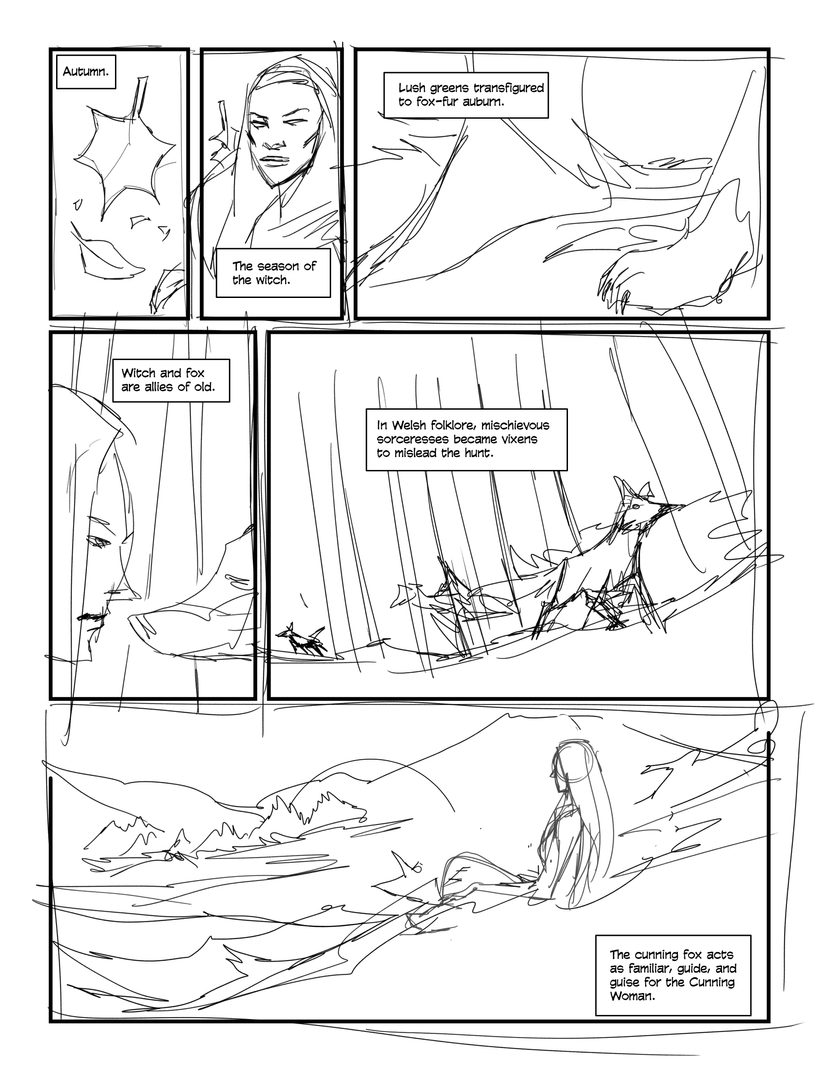
Autumn. The season of the witch. Lush greens transfigured to fox-fur auburn. Witch and fox are allies of old. In Welsh folklore, mischievous sorceresses became vixens to mislead the hunt. The cunning fox acts as familiar, guide, and guise for the Cunning Woman.
—-
September 22nd marks the 2020 Autumnal Equinox in the Northern Hemisphere. Mabon, Harvest Home, the Feast of the Ingathering, Meán Fómhair, An Clabhsúr, or Alban Elfed are names given to Neo-Pagan festivals which take place at the turning of the season. All are thanksgiving festivals – giving thanks to the Gods and Goddesses for Summer’s bounty and hoping to secure their blessings for the months ahead.
The American poet, academic, and Neo-Pagan Aidan A. Kelly is widely credited with introducing the name Mabon in the 1970s. Mabon ap Modron is a prominent figure in Welsh mythology, said to have fought alongside King Arthur. Tales of Mabon ap Modron are said to stem from an older Celtic God, or demi-God figure, Mabon – the son of the Mother Goddess – and so the modern festival is named in his honour.
The word witch has been used in a derogatory fashion for many centuries, only to be embraced and reclaimed by magical practitioners in the last hundred years or so. Before this reclamation, the most simple definition of witch was a practitioner of malevolent Black Magic; using their knowledge and skills to (attempt to) cause hardship, misfortune, and harm to others. Yet, there have always also been those who practice White Magic; using their powers to help and to heal. Rather than “witch”, these Folk Healers have long been known as Wise Women and Men (“dynion hysbys” in the Welsh Language), or Cunning Folk, amongst other names.
The distinction between evil, Satanic witches and the benevolent, often Godly, Cunning Folk was so clearly defined in the minds of the general populace that, even during the Witch-Trials of the 17th-century, few of these Wise Women and Men stood accused in England or Wales. Of those who did, few Cunning Folk were ever convicted of the crime of witchcraft because, even though there was little or no doubt in the minds of those who knew them that these people possessed magical knowledge and performed magical acts regularly, theirs was a wholly separate class of magic.
The distinction between these two classes of magic and two kinds of practitioners remained clear well into 18th-century until the Witchcraft Act of 1736 was passed. Legally, after that Act came into force, magic no longer existed. Anyone claiming to have magical powers, or to offer magical services was, therefore, a fraud; Wise Woman or witch, the crimes and the penalties were the same. From this point on the line between the two magics became increasingly blurred, and the word “witch” did just as well for anyone.
The mischief of witches is well known […] In North Glamorgan witches sometimes took the form of a fox. The animal baffled the hounds, and led huntsmen into dangerous places. Neither mask nor brush would the huntsmen have when the witch led them. – from Folk-lore and folk-stories of Wales, by Marie Trevelyan (1909)
Both witches and Cunning Folk have their familiars – their magical guides, companions, and helpers. In the case of Cunning Folk, they might be said to be faeries (although it is worth mentioning that, in 17th-century Scotland, several witches were convicted and executed for consorting with the Fae), while the witches’ must surely be demons, but in either case, familiars appeared most often in the forms of animals.
In Japanese folklore, the most popular magical familiar by far is the fox, or “Kitsune“. Kitsune are believed to possess inherent magical powers, and one ancient method of gaining magical knowledge – essentially of becoming a witch – was to feed, befriend, and tame one of these creatures. Kitsune can assume human form and, according to the old legends, particularly enjoy becoming young, attractive women. Many Japanese folk tales tell of men unwittingly seduced by foxy women.
“Certain wicked women, reverting to Satan, and seduced by the illusions and phantasms of demons, believe and profess that they ride at night with Diana on certain beasts, with an innumerable multitude of women, passing over immense distances, obeying her commands as their mistress, and evoked by her on certain nights.” [5] – from Malleus Maleficarum (1486), Chapter III, “How they are Transported from Place to Place”.
The Gandreið – “Witches’ Ride” – long depicted as the chaotic broomstick-flight towards the Black Sabbat – is now interpreted by many scholars of witchcraft not as a bodily flight through the air, but as a spiritual one. The practitioner often guided by an animal on their journey, or sometimes taking the form of an animal themselves. “Sent out” from the physical self via meditation, lucid dreaming, or other Shamanic means, the practitioner (who might call themselves a witch) may become a fox. … a hare, a crow, a cat, a moth… They may see through the eyes of another. Gain knowledge and understanding of the world beyond their own everyday experiences. They may learn the Kitsune’s secrets. They may baffle the hounds, and lead the huntsmen into dangerous places.